

Descripció
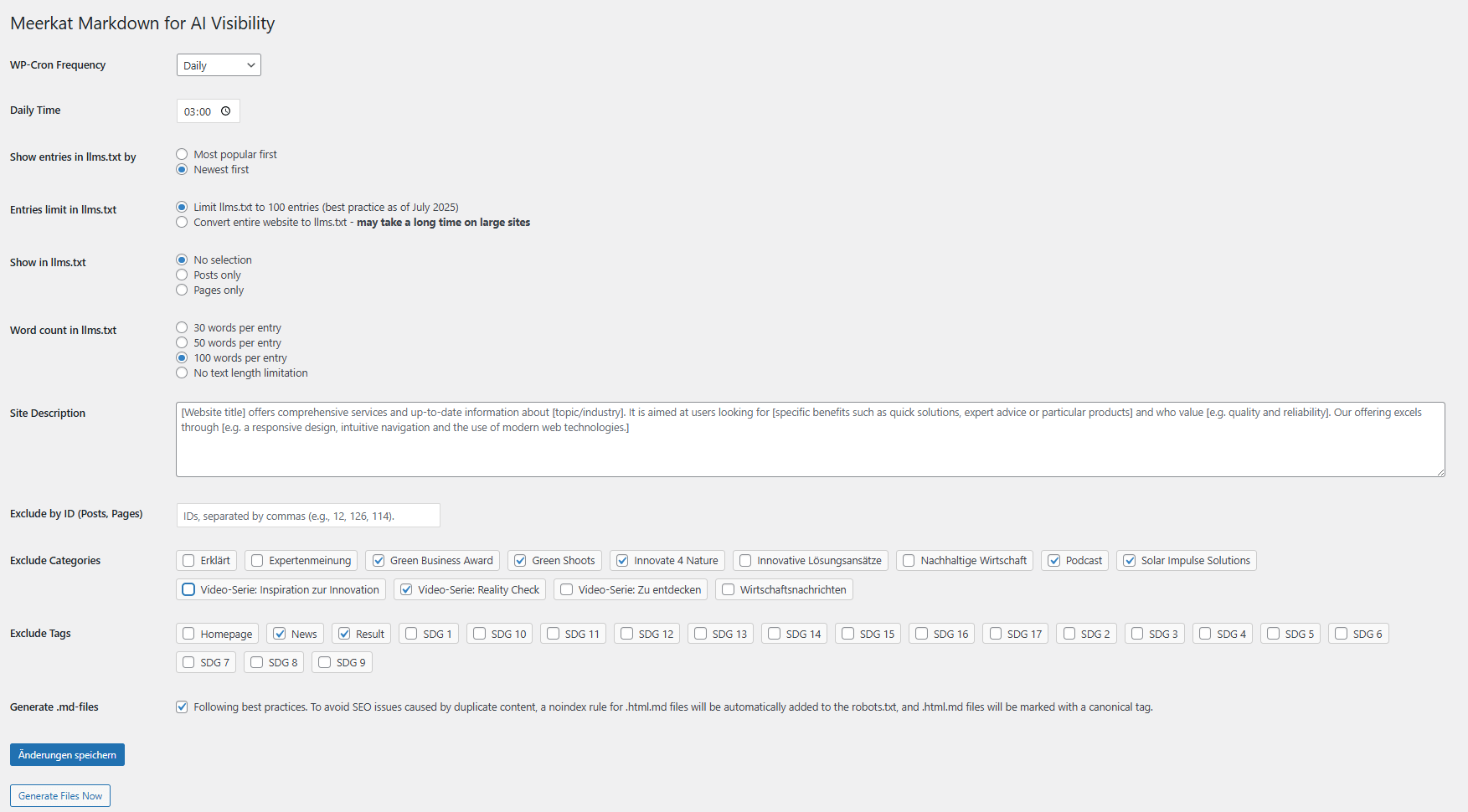
Meerkat Markdown for AI Visibility collects URLs using WordPress queries and generates an llms.txt file (short for “Large Language Models”) in the website’s root directory — optionally providing dynamic .md files — to help AI-based systems better understand and make use of the site’s content. The llms.txt is stored in the root directory. You can configure the number of URLs, set a minimum word count, and exclude specific categories or tags. File generation can be triggered manually or scheduled to run automatically.
Features
- Gathers URLs with WordPress queries; the
wp-sitemap.xmlURL is only added tollms.txtas metadata. - Creates
llms.txtwith[Title • host/path](URL): contententries. - Add a custom site description to the file header.
- Limit export to 100 entries or process all URLs.
- Posts or pages with fewer than 15 words are skipped: they do not count toward
the 100-entry limit and are omitted fromllms.txt. - Choose 30, 50, 100 words or the full text per entry.
- Exclude categories and tags.
- Sort
llms.txtentries by popularity or most recent first. - Optionally serve dynamic
.mdfiles for published posts, pages and public custom post types. Responses include canonical, noindex and MIME-sniffing protection headers. - Generates a valid XML sitemap for Markdown URLs without declaring
llms.txtas a sitemap or blocking it inrobots.txt. - Manual generation via the Generate Files Now button.
- Timezone-aware WP-Cron schedule (hourly, daily, weekly, monthly or disabled) with configurable local run time and daylight-saving-safe rescheduling.
- Save settings with the Save Changes button.
License
This plugin is open source software licensed under the GPLv2 (or later). See LICENSE.txt for license information.
Captures
Instal·lació
- Upload the
meerkat-markdown-for-ai-visibilityfolder to/wp-content/plugins/. - Activate the plugin through the Plugins menu.
- Visit Settings Markdown for AI and click Generate Files Now to create the first file.
PMF
-
Where is `llms.txt` stored?
-
It is written to the site root directory (same level as the top-level
index.php). -
How can I regenerate it?
-
Use the Generate Files Now button or wait for the scheduled cron run.
-
How do I change the schedule?
-
Select a new frequency and click Save Changes on the settings page.
-
What happens when I uninstall the plugin?
-
All plugin options and generated sitemap files are removed automatically. The plugin deletes
llms.txtonly when the file can be identified as plugin-generated. Existing files created manually or by another plugin are preserved. -
How do I enable the dynamic sitemap?
-
Add the following snippet to your theme’s
functions.phpor a small helper plugin:add_filter( 'mrmrkdofa_enable_dynamic_sitemap', '__return_true' );Afterwards visit Settings Permalinks and save changes once so WordPress refreshes the rewrite rules.
Ressenyes


Col·laboradors i desenvolupadors
«Meerkat Markdown for AI Visibility» és programari de codi obert. La següent gent ha col·laborat en aquesta extensió.
Col·laboradors
“Meerkat Markdown for AI Visibility” s’ha traduït a 1 configuració regional. Gràcies als traductors per les seves aportacions.
Traduïu «Meerkat Markdown for AI Visibility» a la vostra llengua.
Interessats en el desenvolupament?
Navegueu pel codi, baixeu-vos el repositori SVN, o subscriviu-vos al registre de desenvolupament per fisl de subscripció RSS.
Registre de canvis
4.2
- Protects existing
llms.txtfiles: files not owned by this plugin are neither overwritten nor removed during uninstall. - Manages only a clearly marked plugin block in
robots.txtand preserves all unrelated directives. - Supports dynamic Markdown URLs with plain WordPress permalinks through query-based endpoints.
- Propagates failed write, delete, permission and directory operations instead of reporting false success.
- Removes dynamic Markdown rewrite rules reliably when the feature or plugin is disabled.
- Corrects the settings description for canonical and X-Robots-Tag headers.
- Updates repository metadata and moves older release notes to changelog.txt.
- Regenerates the translation template from the current source.
- Renames plugin classes and methods to WordPress-compatible naming conventions and normalizes formatting.
- Prevents shortcodes from being executed twice during llms.txt generation.
- Validates sitemap XML before accepting a fallback endpoint.
- Stages and rolls back generated files so failed sitemap generation does not partially update llms.txt.
4.1
- Adds a defensive DOMNode guard clause to the HTML-to-Markdown parser.
- Prevents PHP warnings when an unexpected or null node is passed to the recursive node processor.
4.0
Major improvements
Security
- Limits dynamic Markdown output to published, publicly accessible and non-password-protected content.
- Drafts, private posts and password-protected content are no longer exposed through
.mdURLs. - Unknown Markdown URLs return a real HTTP 404 response instead of homepage content.
- Uses safe remote requests, validates AJAX permissions and adds canonical, noindex and MIME-sniffing protection headers.
Generation, sitemaps and scheduling
- Supports public custom post types and Elementor, Divi and Avada content.
- Generates a valid Markdown XML sitemap and removes obsolete robots.txt directives.
- Processes large sites in batches and validates root, upload and filter values.
- Uses timezone-aware calendar scheduling for hourly, daily, weekly and monthly runs.
- Cleans generated data, options, cron events and legacy robots.txt entries on uninstall.
Earlier release notes are included in changelog.txt.