

Descripció
LinkSolva – Broken Link Checker is a local WordPress tool for administrators who need to know what is genuinely broken before changing content.
It discovers URLs in public posts, pages, public custom post types, approved comments, custom navigation menus, featured images, and optionally scalar custom-field or page-builder data. Findings are grouped by normalized URL, and every matching source location is retained. A check may make more than one HTTP request when it follows redirects or needs a limited GET fallback after HEAD.
The plugin classifies results instead of treating every failed request as a dead link:
- Healthy: a successful response was received.
- Redirect: the destination works but reaches another URL.
- Broken: HTTP 404 or 410 provides strong evidence that the destination no longer exists.
- Blocked: the destination rejected automated verification, such as HTTP 401 or 403.
- Rate Limited: the destination returned HTTP 429 and should be checked later.
- Temporary Error: the destination returned a 5xx response.
- SSL Error, DNS Error, Timeout, or Unverified: the scanner could not establish enough evidence to call the URL broken.
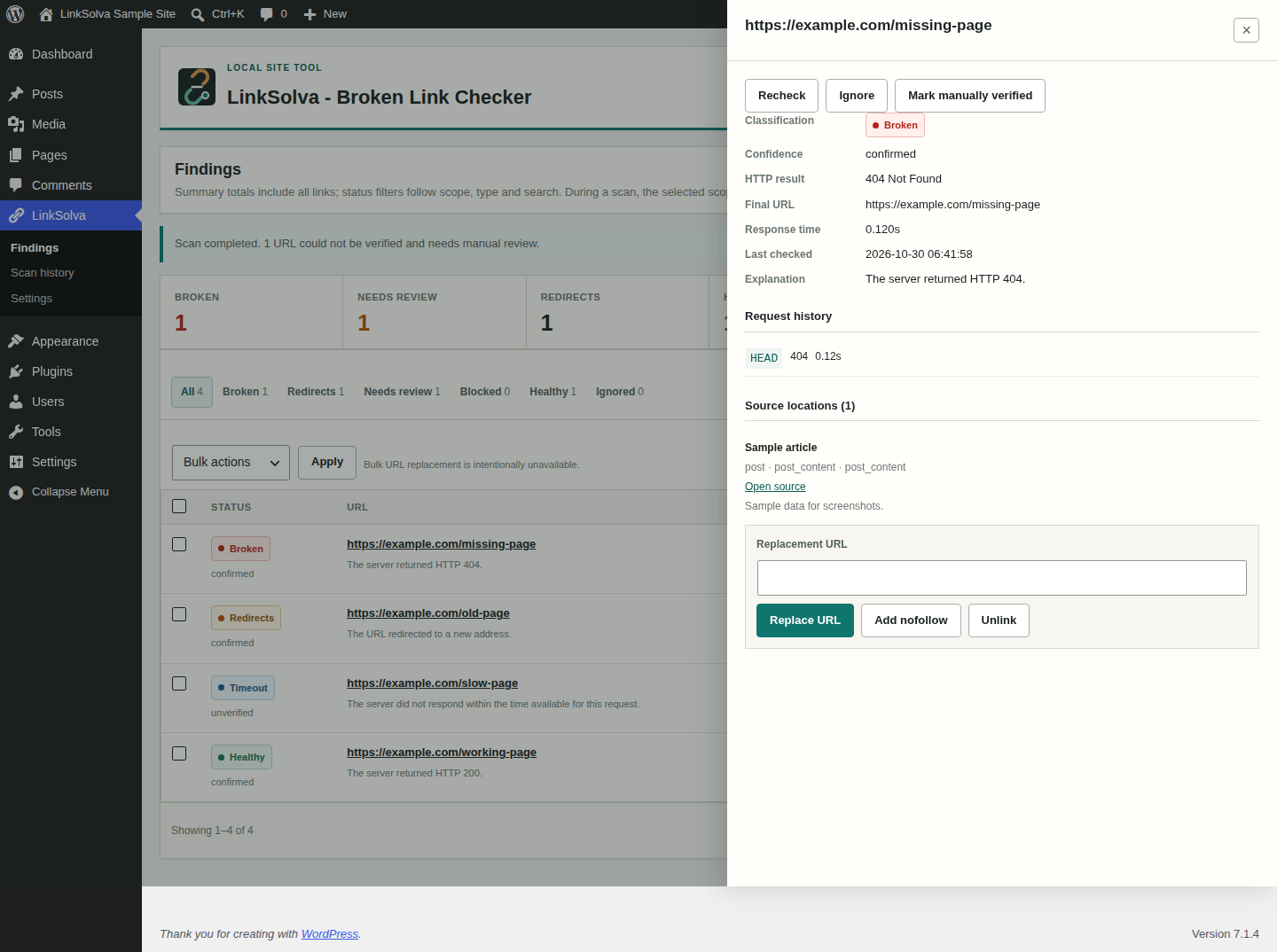
Every result includes request history, redirect chain, response time, confidence, explanation, and source locations.
Completed and stopped scan results can be kept locally for later review. Choose to retain 5, 10, or 25 runs, or turn history off. Saved runs include their URL results and source locations; stopped runs are marked incomplete. The oldest saved run is removed when the selected limit is exceeded. On upgrade, the latest completed run is saved from the findings still stored by the plugin. Results overwritten by earlier scans cannot be restored.
Local by design
- No cloud account.
- No link credits or usage limits imposed by a third party.
- No telemetry, advertising, or developer tracking.
- No URLs or site content are sent to a developer service.
- HTTP requests are made from your WordPress server to the destinations found in your content.
Safe repairs
Supported post content, approved comment content, and custom menu URLs can be replaced, unlinked, or marked nofollow. Builder metadata is read-only in this release. Each repair stores the complete before and after source, the user, time, operation, and checksums. Undo is blocked when the source changed after the repair.
Resource controls
Scanning runs in small resumable worker requests. The scanner checks discovered URLs in small batches as it continues finding more. During discovery, the percentage shows the share of URLs found so far that have been checked; it can change as new URLs are found. Repeated occurrences do not re-queue a settled URL. Only one worker request processes the scan at a time. Worker duration follows PHP’s execution-time limit. Batch size and parallel requests adjust to available PHP memory; no more than four URLs are checked at once. URLs wait for another worker when too little time remains to start a check. Timeouts are retried up to the configured limit; URLs that remain inconclusive are shown for review. Hosting execution limits can shorten the effective request timeout. PHP does not reliably expose shared-host CPU quotas, so the plugin uses conservative concurrency limits rather than claiming to measure CPU availability. Manual scanning remains available when WordPress cron is delayed.
Privacy
This plugin does not create a remote account or transmit data to the developer. The server running WordPress may make requests to external URLs found in your content. The request destination, response status, timing, and limited diagnostic categories are stored in your WordPress database.
Limitations
- Some websites intentionally reject automated verification. A successful browser visit cannot always be reproduced by a server-side request.
- Redirects to private, loopback, link-local, metadata, or otherwise reserved addresses are stopped for SSRF protection.
- Structured page-builder data is review-only until a source-specific safe editor is available.
- WordPress cron may be delayed or disabled by hosting configuration. The findings screen provides manual worker progress.
Captures



Instal·lació
- Upload the
linksolva-broken-link-checkerfolder to/wp-content/plugins/, or install the ZIP from Plugins Add New Upload Plugin. - Activate the plugin.
- Open Link Checker Findings.
- Review Link Checker Settings before starting a large scan.
- Run a scan and open Evidence on any result that needs review.
- Open Link Checker Scan history to view results from saved runs.
PMF
-
Does it use a cloud service?
-
No. All discovery, storage, classification, and repair operations are local to your WordPress installation. The server still requests the URLs it is checking, as any link checker must.
-
Is a 403 link reported as broken?
-
No. A 401 or 403 response is classified as Blocked because automated access was rejected. Other inconclusive failures remain in a review state instead of being called broken.
-
Is a 429 link reported as broken?
-
No. HTTP 429 is classified as Rate Limited and scheduled for a later check.
-
Can it edit page-builder data?
-
The plugin can read scalar metadata when enabled, but it does not rewrite serialized or builder data automatically. This avoids corrupting Elementor, ACF, or other structured content.
-
Can I remove all data on uninstall?
-
Findings and saved scan history stay in the site’s database. Enable Delete findings when the plugin is uninstalled in Settings if you want plugin-owned tables and options removed.
-
How many completed scans can I keep?
-
Choose 5, 10, or 25 runs in Settings, or turn scan history off. When you lower the limit, the oldest saved results are removed.
-
Does it add scripts to the public website?
-
No. Styles and scripts are loaded only on the plugin’s WordPress admin screens.
Ressenyes
No hi ha ressenyes per a aquesta extensió.
Col·laboradors i desenvolupadors
«LinkSolva – Broken Link Checker» és programari de codi obert. La següent gent ha col·laborat en aquesta extensió.
Col·laboradors
Traduïu «LinkSolva – Broken Link Checker» a la vostra llengua.
Interessats en el desenvolupament?
Navegueu pel codi, baixeu-vos el repositori SVN, o subscriviu-vos al registre de desenvolupament per fisl de subscripció RSS.
Registre de canvis
1.0.21
- Speed up findings, show repair errors in the evidence panel, and renew expired REST security tokens for signed-in administrators.
- Give URL checks more time within the available PHP worker limit and retry timeouts automatically before reporting them for review.
- Improve scan progress, filtered findings, history, discovery and recovery on larger sites.
- Hide repair controls for read-only source locations.
1.0.11
- Added WordPress Plugin Check and PHP syntax checks to GitHub Actions.
- Reduced scan polling frequency and improved keyboard operation of the evidence drawer.
- Clarified request-count, concurrency, and interrupted-scan messages.
1.0.10
- Updated the plugin name, directory slug, translation domain, and matching directory graphics for the WordPress.org resubmission.
1.0.9
- Cleared the scan worker lock when the plugin is deactivated or uninstalled, including when findings are retained.
- Required the relevant WordPress source-edit capability before applying or undoing a repair.
- Reused the initial URL safety decision within a parallel batch to avoid an extra DNS validation for each result.
- Paginated navigation-menu discovery so each worker loads only the current small batch of menu items.
1.0.8
- Stopped issuing an immediate GET request after a HEAD network failure or timeout; the URL is recorded as unverified and retried later so the scan can continue.
- Kept batch transport failures and missing responses from triggering a second sequential network attempt.
1.0.7
- Capped each HTTP request to the remaining worker time budget so slow destinations cannot hold a scan request beyond its configured work window.
- Kept unchecked URLs queued for the next worker request when the time budget expires.
- Serialized worker requests so cron and admin polling cannot issue duplicate checks for the same batch.
1.0.6
- Added bounded parallel URL verification with a configurable 1–8 request limit to reduce scan time on large sites.
- Avoided redundant GET requests for definitive 404 and 410 responses while retaining GET fallback for inconclusive HEAD responses.
- Reindexed replacement URLs immediately, verified them before returning success, and retired orphaned old findings.
- Restored the original occurrence/resource mapping on undo and kept replacement and unlink operations auditable.
1.0.5
- Serialized discovery and verification so each discovered batch is classified before more source URLs are fetched.
- Prevented repeated occurrences from resetting an already verified URL to Queued during the same scan.
- Kept ignored resources out of the verification queue while preserving their current-scan visibility.
- Added progress messages and resilient REST polling so active scans continue updating after transient browser requests fail.
1.0.4
- Prevented a scan from completing while current-scan resources remain queued.
- Normalized legacy nullable queue markers during upgrade.
- Removed the stale empty-table row when live results arrive.
1.0.3
- Added Internal links, External links, and All links filtering on the Findings screen.
- Added separate settings to include or exclude internal and external links from scans.
- Reset rediscovered URLs to Queued until their current verification request finishes.
- Updated individual result rows without replacing the complete table body during scan progress.
1.0.2
- Updated scan progress, counters, filters, and result rows in place to prevent dashboard blinking during active scans.
- Preserved the dashboard shell and filter controls while new findings are added.
- Added bounded GET verification when a server rejects or fails a HEAD request.
- Distinguished URLs waiting in the scan queue from completed unverified results.
- Made every new manual or scheduled scan retry previously inconclusive URLs instead of silently skipping them.
1.0.1
- Fixed admin REST requests on sites using plain permalinks.
- Improved DNS failure classification and nonstandard-port URL resolution.
- Preserved every repeated source occurrence while checking each unique URL once.
- Hardened repair auditing, undo behavior, recheck scheduling, translations, and admin asset loading.
- Added a one-minute bounded worker continuation and refreshed WordPress.org release assets.
1.0.0
- New local-only broken link and image checker.
- Added evidence-based HTTP classifications, URL deduplication, bounded scanning, safe repairs, and conflict-aware undo.